# Fields

> Browse PeopleSoft field definitions with cross-references to records, pages, PeopleCode, component interfaces, queries, and projects.

---

LLMS index: [llms.txt](/llms.txt)

---

<div id="pslens-context-panel" class="card border-info mb-4 d-none">
  <div class="card-header bg-light text-info py-2 fw-bold d-flex align-items-center border-bottom border-info-subtle">
    <i class="bi bi-info-circle-fill me-2"></i>
    <span>Tailored Operational Context</span>
  </div>
  <div class="card-body p-0">
    <ul class="list-group list-group-flush">
      <li id="row-db" class="list-group-item d-flex align-items-center justify-content-between py-2 d-none">
        <strong>Target Database:</strong>
        <span id="ctx-db" class="badge bg-secondary font-monospace">&mdash;</span>
      </li>
      <li id="row-type" class="list-group-item d-flex align-items-center justify-content-between py-2 d-none">
        <strong>Context Type:</strong>
        <span id="ctx-type" class="badge bg-light text-dark border font-monospace text-uppercase">&mdash;</span>
      </li>
      <li id="row-severity" class="list-group-item d-flex align-items-center justify-content-between py-2 d-none">
        <strong>Alert Severity:</strong>
        <span id="ctx-severity" class="badge">&mdash;</span>
      </li>
      <li id="row-time" class="list-group-item d-flex align-items-center justify-content-between py-2 d-none">
        <strong>Triggered Time:</strong>
        <span id="ctx-time" class="text-muted small">&mdash;</span>
      </li>
      <li id="row-details" class="list-group-item py-2 d-none">
        <strong id="label-details" class="d-block mb-1">Firing Context:</strong>
        <code id="ctx-details" class="d-block p-2 bg-light border rounded small" style="white-space: pre-wrap; word-break: break-all;">&mdash;</code>
      </li>
    </ul>
  </div>
</div>

<script>
  (function() {
    const params = new URLSearchParams(window.location.search);
    const metadata = params.get('metadata');
    if (!metadata) return;

    try {
      
      const base64 = metadata.replace(/-/g, '+').replace(/_/g, '/');
      const jsonStr = decodeURIComponent(escape(window.atob(base64)));
      const data = JSON.parse(jsonStr);

      if (data) {
        let hasData = false;

        if (data.db) {
          document.getElementById('ctx-db').textContent = data.db;
          document.getElementById('row-db').classList.remove('d-none');
          hasData = true;
        }

        if (data.type) {
          document.getElementById('ctx-type').textContent = data.type;
          document.getElementById('row-type').classList.remove('d-none');
          hasData = true;
        }

        if (data.severity) {
          const severityBadge = document.getElementById('ctx-severity');
          const severity = data.severity.toLowerCase();
          severityBadge.textContent = severity.toUpperCase();
          if (severity === 'critical') {
            severityBadge.className = 'badge bg-danger';
          } else if (severity === 'warning') {
            severityBadge.className = 'badge bg-warning text-dark';
          } else {
            severityBadge.className = 'badge bg-info';
          }
          document.getElementById('row-severity').classList.remove('d-none');
          hasData = true;
        }

        if (data.t) {
          const date = new Date(data.t * 1000);
          document.getElementById('ctx-time').textContent = date.toLocaleString();
          document.getElementById('row-time').classList.remove('d-none');
          hasData = true;
        }

        if (data.details) {
          document.getElementById('ctx-details').textContent = data.details;

          
          const labelDetails = document.getElementById('label-details');
          if (data.type === 'object') {
            labelDetails.textContent = 'Object Metadata Details:';
          } else if (data.type === 'report') {
            labelDetails.textContent = 'Report Description:';
          } else {
            labelDetails.textContent = 'Firing Context:';
          }

          document.getElementById('row-details').classList.remove('d-none');
          hasData = true;
        }

        if (hasData) {
          document.getElementById('pslens-context-panel').classList.remove('d-none');
        }
      }
    } catch (e) {
      console.error('Failed to parse operational context metadata:', e);
    }
  })();
</script>


## What It Is

Fields are the atomic units of a PeopleSoft application. Every column on every page and every row in every table is built on top of a field definition. psLens reads field definitions from `PSDBFIELD` (and field labels from `PSDBFLDLABL`) and stitches them together with the rest of the metadata so you can see, in one place, everywhere a given field is used.

## Search Page

URL: `/fields?db={database}`

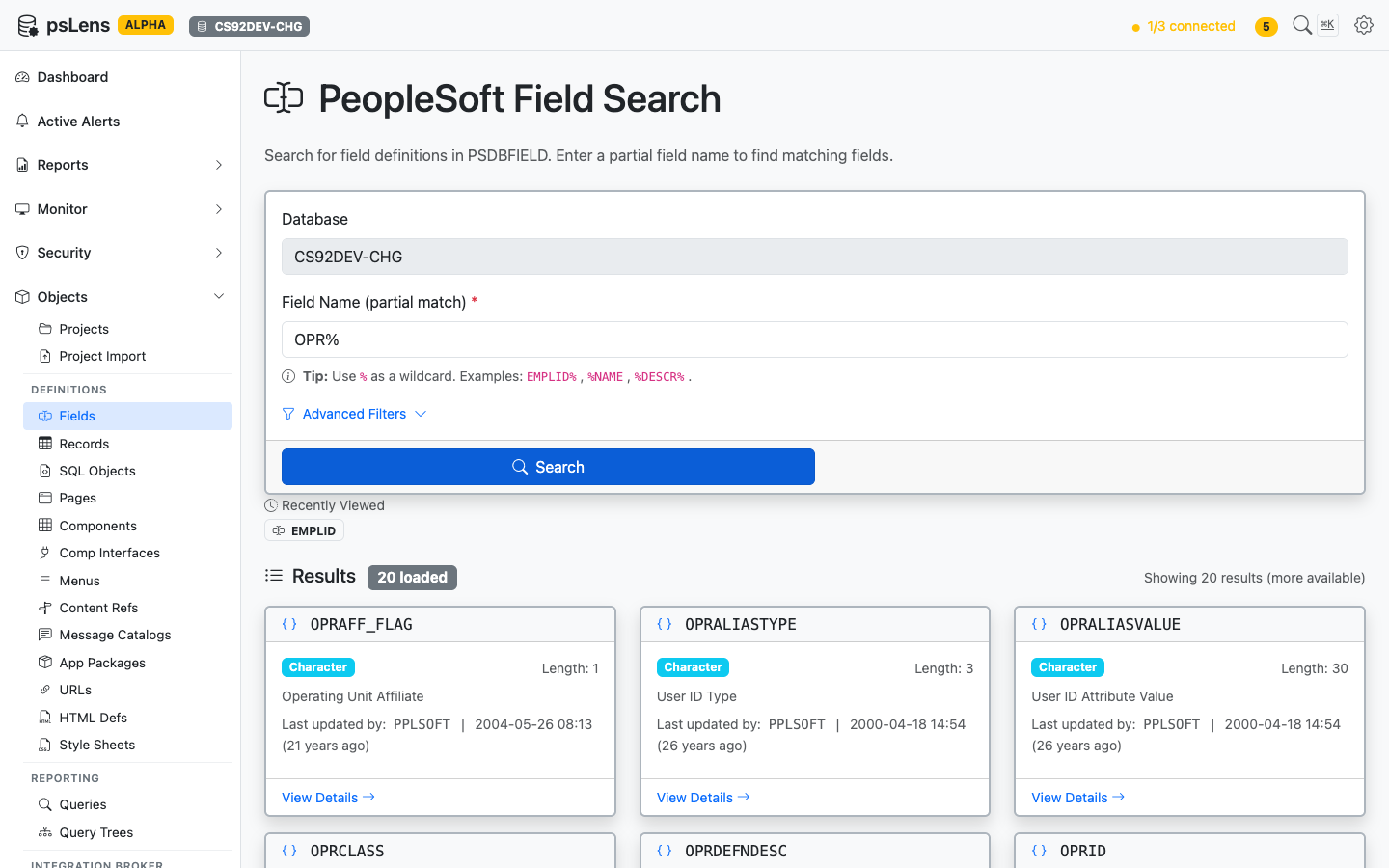
<figure><img src="/images/screenshots/metadata/fields-search.png"
    alt="Field search results showing OPRAFF_FLAG, OPRALIASTYPE, and other fields matching OPR%"><figcaption>
      <p>Field search results for <code>OPR%</code></p>
    </figcaption>
</figure>


Type a partial field name to find matching definitions. Search auto-matches as *starts with* — `EMPLID` finds `EMPLID`, `EMPLID_TBL`, `EMPLID_PNL`, etc. Include `%` yourself for more control: `%NAME` (ends with), `%DESCR%` (contains), or just `%` to list every row. Each result card shows the field type and length, the long-name description, and the last-updated timestamp so you can spot recently modified objects at a glance. The **Advanced Filters** panel lets you narrow by field type, last-updated date, or owner. Recently viewed fields are surfaced just above the results.

## Detail Page

URL: `/fields/{FIELDNAME}?db={database}`

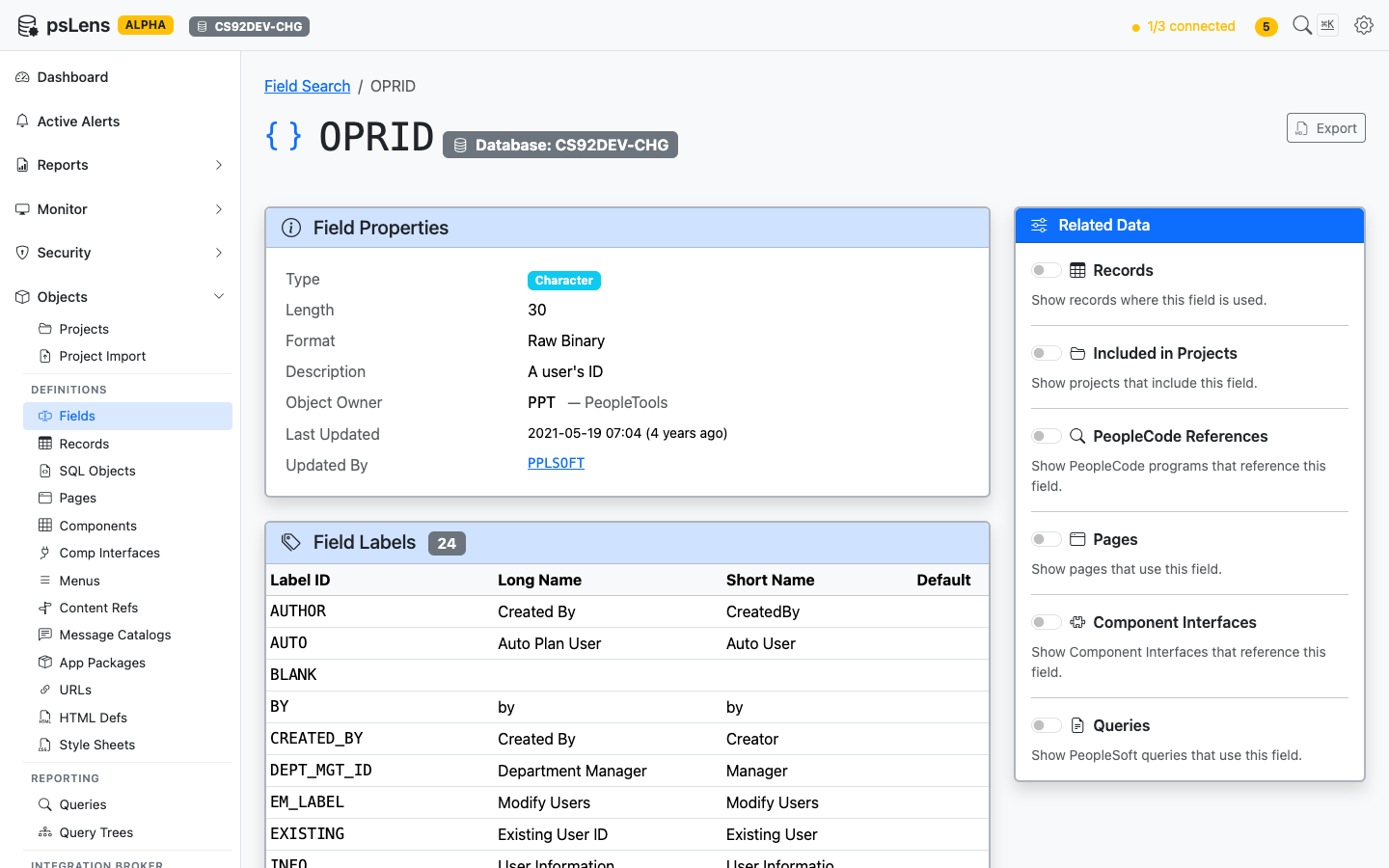
<figure><img src="/images/screenshots/metadata/fields-detail.png"
    alt="Detail page for the OPRID field showing properties, field labels, and the Related Data sidebar"><figcaption>
      <p>Field detail page for <code>OPRID</code> — default view, no panels expanded</p>
    </figcaption>
</figure>


The main pane shows the **Field Properties** card (type, length, format, description, object owner, last-updated metadata) and a **Field Labels** card with every long/short name pair defined in `PSDBFLDLABL`, including which one is the default label. The **Export** button in the top right downloads the full definition as Markdown. The **Related Data** sidebar holds six toggles that fetch additional context on demand.

## Related Data Panels

Toggle any panel on to load it inline beneath the main content. Each panel returns the count of objects found and a sortable list with deep-links into the corresponding psLens detail pages, so you can chase a field reference into the record, page, or PeopleCode program that uses it without losing your place.

### Records

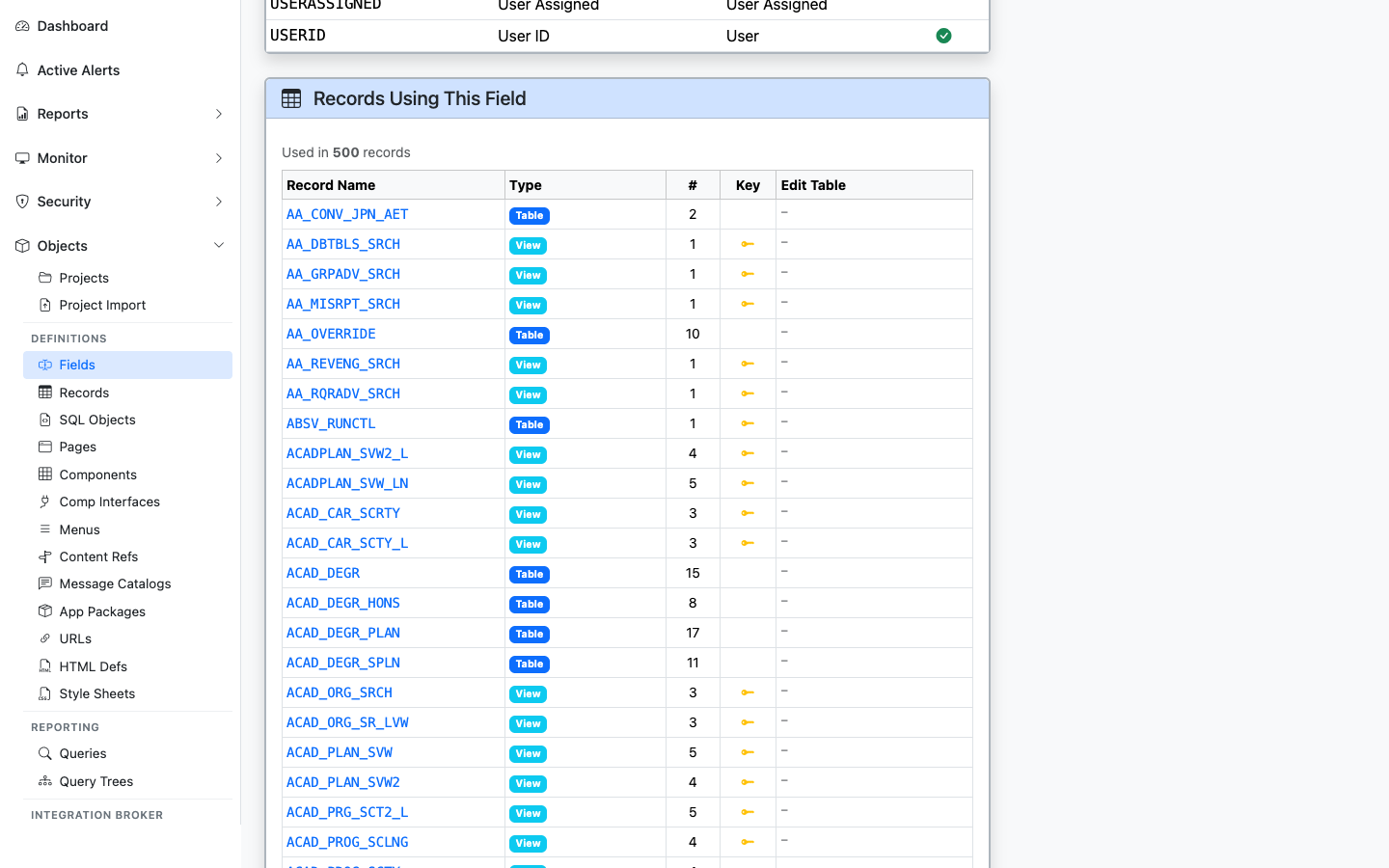
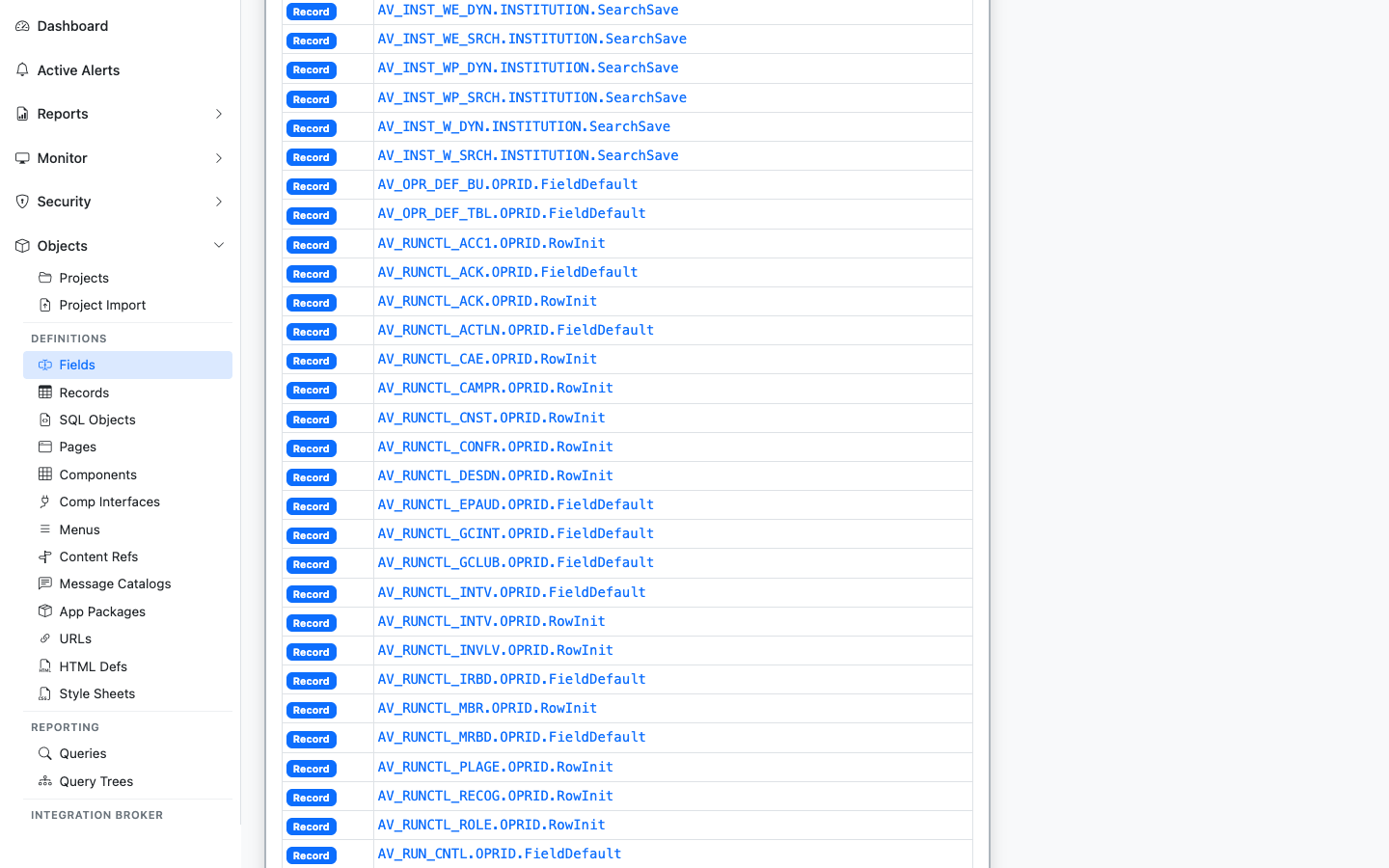
<figure><img src="/images/screenshots/metadata/fields-panel-records.png"
    alt="Records Using This Field panel showing 500 records that contain OPRID"><figcaption>
      <p>Every record that includes this field, with type (Table/View) and Edit Table indicator</p>
    </figcaption>
</figure>


Lists every record where the field appears, with record type, the position number within the record, key-field indicator, and whether the field is configured with an Edit Table prompt. Sourced from `PSRECFIELD` / `PSRECFIELDDB`.

### Included in Projects

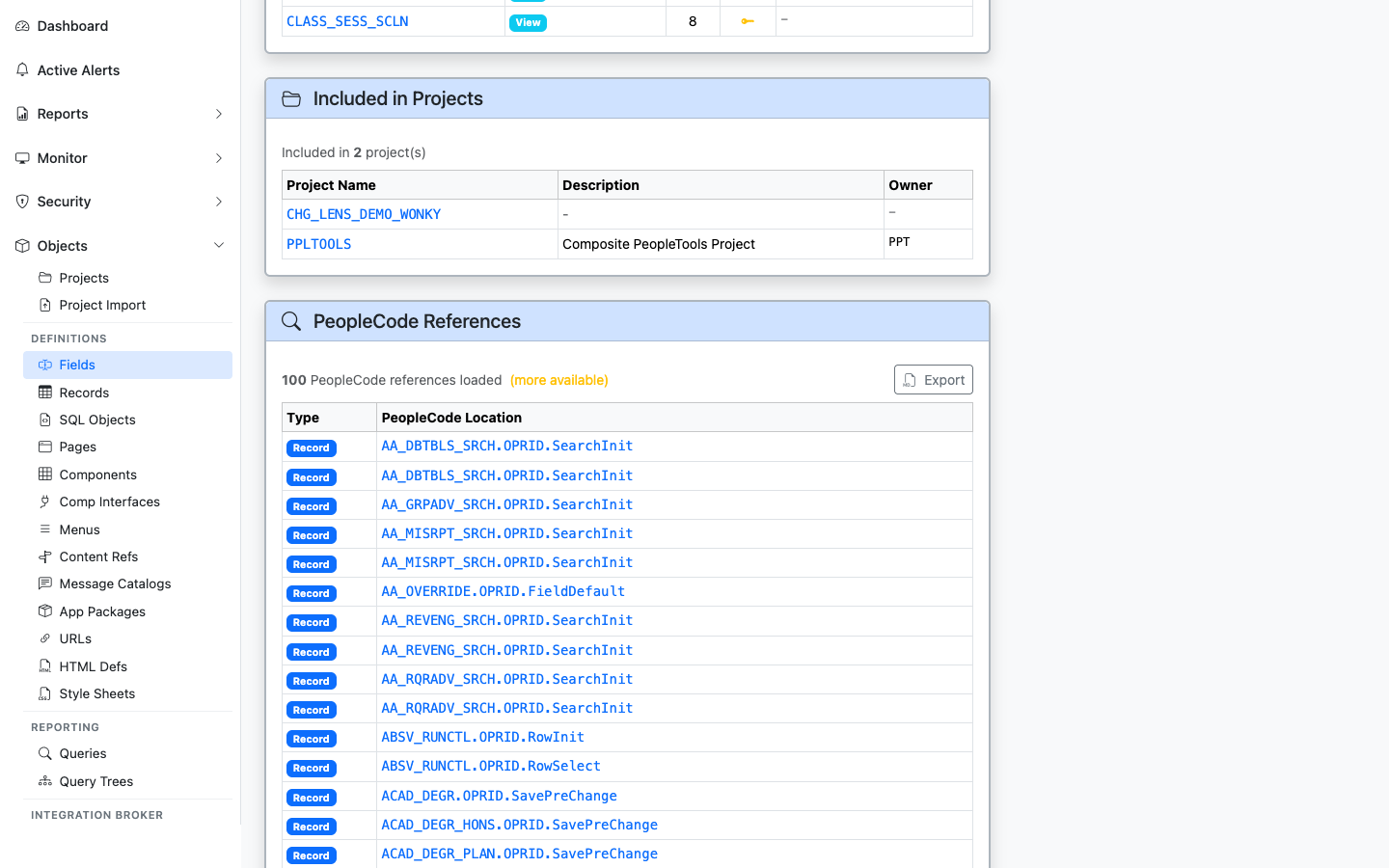
<figure><img src="/images/screenshots/metadata/fields-panel-projects.png"
    alt="Included in Projects panel for the OPRID field"><figcaption>
      <p>App Designer projects that include this field</p>
    </figcaption>
</figure>


Shows every App Designer project (`PSPROJECTITEM`) that contains this field as a project item. Useful for tracing which customization or release introduced or modified the field.

### PeopleCode References

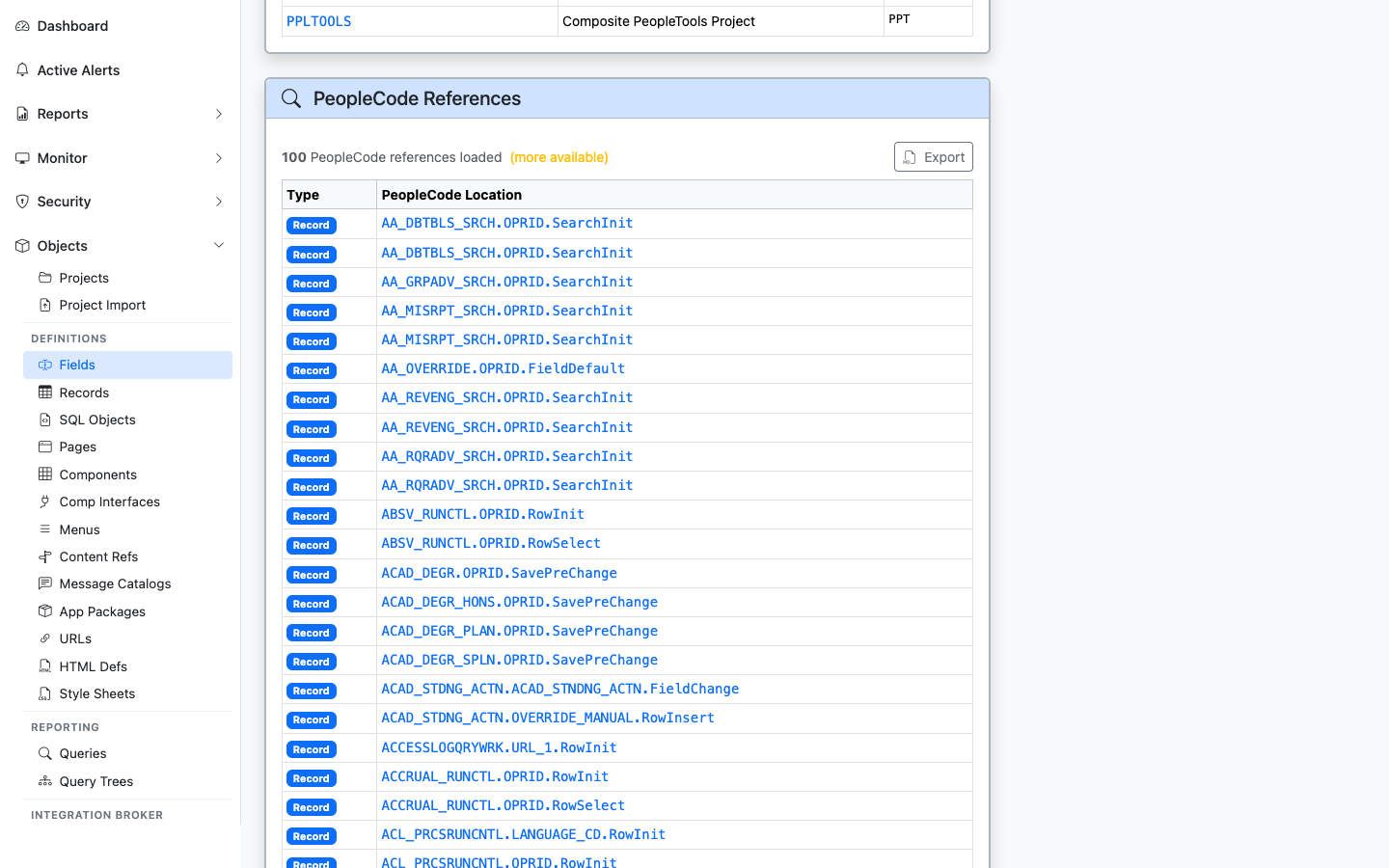
<figure><img src="/images/screenshots/metadata/fields-panel-peoplecode.png"
    alt="PeopleCode References panel showing PeopleCode programs that reference OPRID"><figcaption>
      <p>PeopleCode programs that reference this field</p>
    </figcaption>
</figure>


Lists PeopleCode programs that mention the field: record PeopleCode, component PeopleCode, application package methods, and more. Each result links to the parent object's detail page so you can drill into the program.

### Pages

<figure><img src="/images/screenshots/metadata/fields-panel-pages.png"
    alt="Pages Using This Field panel showing pages that bind the OPRID field"><figcaption>
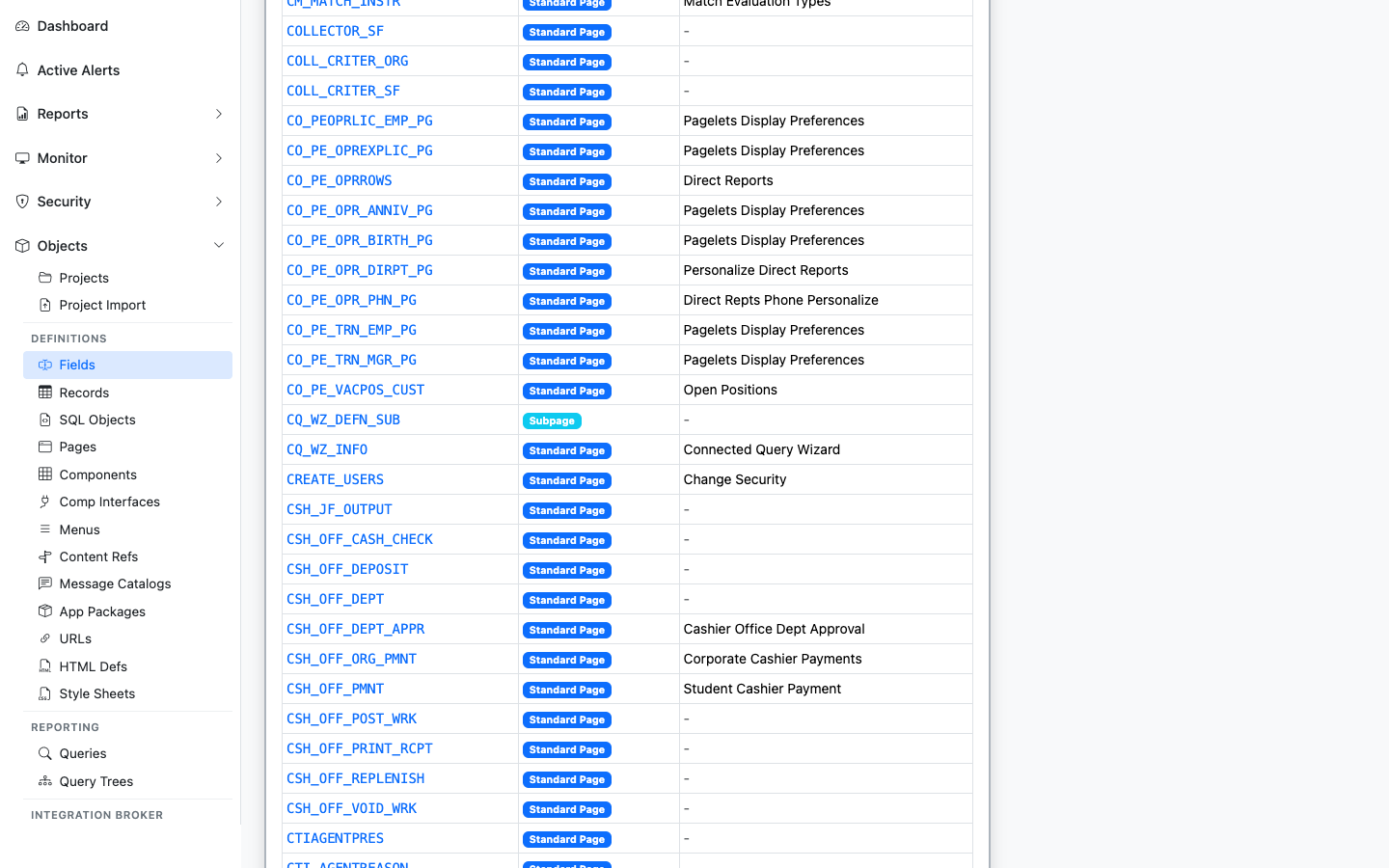
      <p>Pages with field controls bound to this field</p>
    </figcaption>
</figure>


Lists pages (`PSPNLFIELD`) where a control on the page is bound to this field, with the record context. Useful for impact analysis when changing a field's type or length.

### Component Interfaces

<figure><img src="/images/screenshots/metadata/fields-panel-componentinterfaces.png"
    alt="Component Interfaces Using This Field panel"><figcaption>
      <p>Component Interfaces that expose this field as a property</p>
    </figcaption>
</figure>


Lists Component Interfaces that expose this field as a CI property. The integration surface area for the field. Sourced from `PSBCITEM`.

### Queries

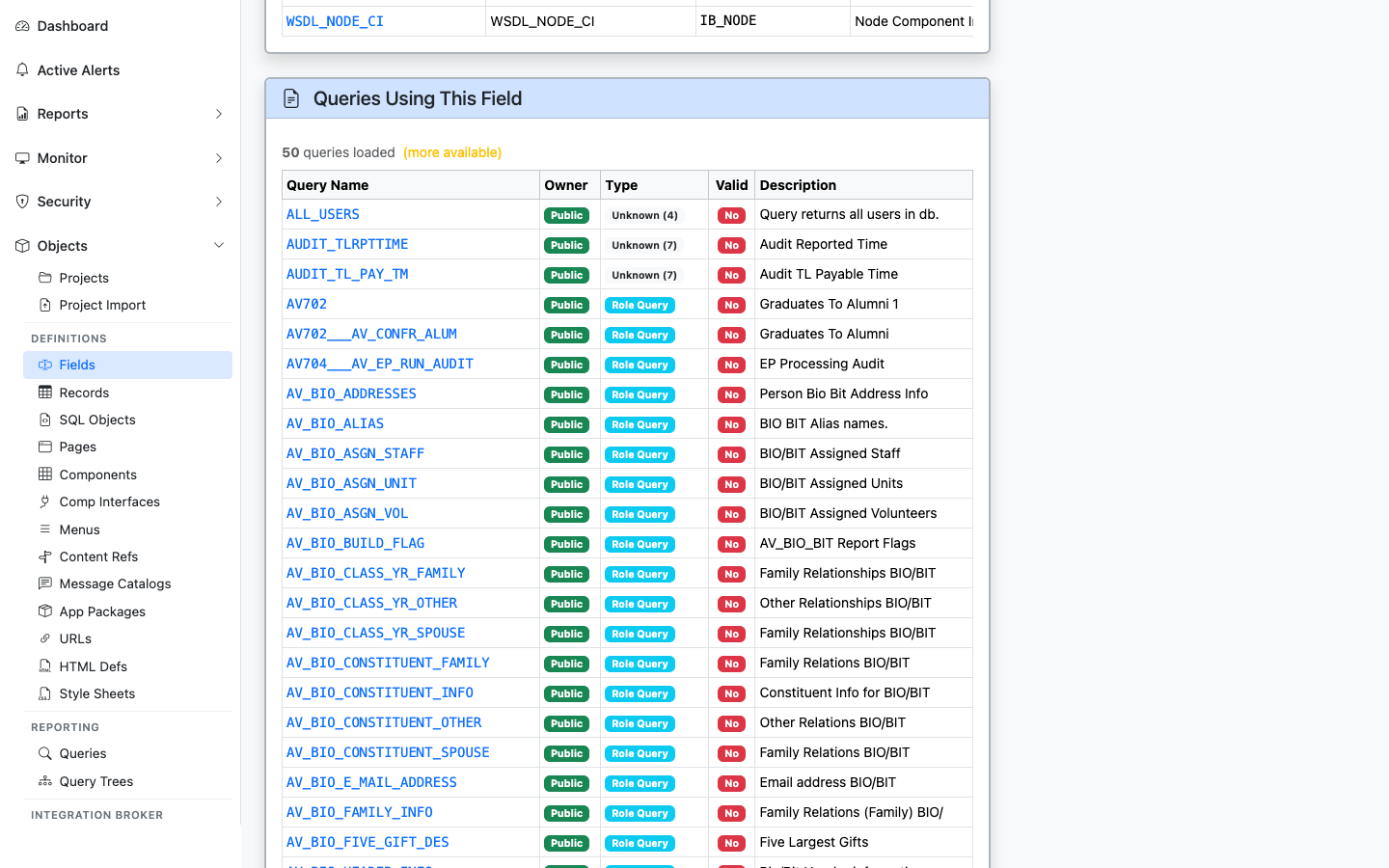
<figure><img src="/images/screenshots/metadata/fields-panel-queries.png"
    alt="Queries Using This Field panel"><figcaption>
      <p>PeopleSoft Queries that reference this field</p>
    </figcaption>
</figure>


Lists PeopleSoft Queries (`PSQRYFIELD`) that reference this field in a SELECT, WHERE, or ORDER BY. Useful for security and audit work: "who has reports built on this column?"

## What This Consolidates

In App Designer, assembling this same picture requires:

- Open the field in App Designer for properties and labels
- Right-click → **Find Object References** for record usage
- Run a separate **Find In** search across all PeopleCode for code references
- Manually run SQL against `PSPNLFIELD` and `PSBCITEM` to find page and CI usage
- Open Query Manager and run cross-database searches for query references
- Open each containing App Designer project one at a time to confirm migration history

psLens collapses all of that into a single page with one toggle per question.